


Greener Eynsford Blog
Green news and views relevant to our community
Biogas Powerplant
25th August 2022
The Darenth Valley’s Biogas Powerplant
by Erica Russell on behalf of the Green Team
Visiting a large scale anaerobic digestor is not a usual agenda item for the Parish green team but we were all curious to find out more about the ‘mini powerplant’ that has been built near Horton Kirby. Firstly, what is it?! This particular powerplant is driven by anaerobic digestion. This process relies on bacteria and microbes to break down plant material to create biogas, which in turn can be treated to allow the gas to be used for heating and cooking or to produce electricity. The process also creates biofertilizer than can go back onto the land. Across the UK anaerobic digestors recycle 2.5m tonnes of food waste each year.

The site is large, much bigger than any of us had expected. Oncoland Energy have spent over £10m on the plant and it’s run by a full-time manager and two staff. Initially designed to help spread the risk of fluctuating crop prices the digestor is also helping manage difficult agricultural waste, some of which produces large amounts of atmosphere warming gas – methane. Many of us in Eynsford will be familiar with at least one of the feedstocks used by the digestor – slurry from Bower Lane Farm! But, the site also takes in a lot of waste parts of crops, unwanted/oversized produce, including and rather surprisingly waste pomegranate skins. Carl explained that the site is working hard to develop relationships with local food processors to take on similar materials. The farm also grows some crops themselves to balance the nutrients within the digestor.

Digestor is a good description when thinking about how the process works – the feedstock is mashed and chopped up in a large machine (the mouth), fed into ‘the stomach’ through pipes, with biogas drawn off from the large digestors and then the odourless biofertilizer ‘waste’ is moved out into storage bays, before being used by local farms – very little is wasted.

Treating the biogas is complex and heavily regulated but the site is now producing enough back to the gas network to heat 2500 homes. The plant also has a small generator which, fuelled by biogas is putting electricity into the grid – about enough to light around 600 homes a year.
It was a fascinating visit, and we must give huge thanks to Carl Woolley, the site manager, who gave up his evening to show us around and explain the process.
We came, we repaired, we raised money!
16th June 2022
On Saturday 21st May, Eynsford's Green Team ran their first-ever Repair Cafe at Eynsford Village Hall!
Volunteers had been recruited from the local community to help with repairs including IT, bikes and textiles.
Unfortunately, our hoover repair man was unable to attend at the last minute, so other volunteers 'had a go' instead!
We sold some lovely tea and cake to people waiting for their turn. Visitors were encouraged to make a donation to the new village hall fund http://eynsfordvh.com/wp/how-t... and £150 was raised!
We hope to run the repair cafe again in the autumn and would love to recruit a few more volunteers to give up a few hours to help people to repair their stuff.
Thank you to Chris Lewington for the fab photos.


Repair Cafe for Eynsford
5th May 2022
The Green Team are organising a pop-up repair cafe in Eynsford to help the community reduce waste.
This is an opportunity for members of the community to get their items fixed rather than throwing them away and replacing them with new goods. Repairing and mending old and damaged items is becoming more popular. TV's The Repair Shop has raised interest, although we cannot offer repairs quite to that standard.
The Green Team and other volunteers will be offering simple repairs to clothes, toys and bikes. Residents will be able to see and maybe help with the repair, so that next time they will be able to do it themselves. We will not be offering electrical repairs at this point. If we can't help you, we might be able to point you in the direction of someone who can. Everyone is welcome.
Visible repairs have also gained popularity. The Japanese art of Kintsugi sees pottery being glued back together, but then the cracks are painted with gold. Rather than rejoin ceramic pieces with a camouflaged adhesive, the kintsugi technique employs a special tree sap lacquer dusted with powdered gold, silver, or platinum. Once completed, beautiful seams of gold glint in the conspicuous cracks of ceramic wares, giving a one-of-a-kind appearance to each “repaired” piece. Visible mending of clothing is also becoming more popular, with decorative stitches such as sashiko or boro stitching, or embroidering designs around holes to make them into a new feature.
As people start to value the resources that have gone into making their clothes and other belongings, hopefully they will aim to use them for as long as possible, or pass them onto someone else to use.
Where is our heat (and money) going?
15th March 2022
Where is our heat (and money) going?
Quite a few people borrowed the digital thermal imaging camera over the winter months to try and spot where they were leaking heat, and with rising energy costs and worry about climate change it's good to find out. We had some great feedback and we thought you might like to see some of the pictures and ideas that have been put into action.
And for anyone who would like to try this out for themselves, we hope to have the camera available again in the future.
The glowing front door!
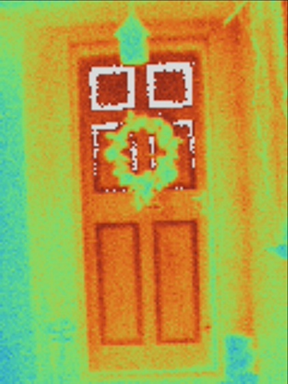
We’ve always known the hall was cold and a bit draughty but were really shocked to see just how much heat is being lost through the door – it was not just red hot, but white hot. It’s a solid, paneled wood door, and we hadn’t realized how thin the wood is at the edges of each panel……the door is just leaking heat. In fact, the Christmas door wreath is probably more insulating than most of the wood! We thought about getting a new door, but the door is not a standard size, so it would need to be custom made. So, instead, we’re putting up a hinged curtain pole and a big door curtain, both of which can be removed in the summer. Next winter we’re hoping that our door picture is definitely looking less rosy and the hall rather warmer.
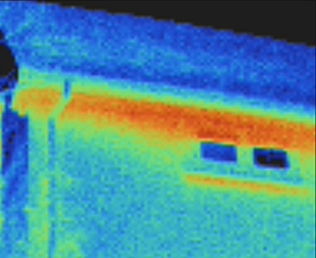
We also had a walk around the outside of the house and realized that despite the cavity wall and room insulation and double glazing we had a few hot spots. The roof insulation was working well but at the top of the walls there was a gap, possibly where insulation has settled and something we’re going to check.
Uninsulated and draughty floors
We used the Thermal Imaging Camera on a chilly evening in November. We used it inside and outside the house. Our house is old with part of it dating back to 1681. With the upper house constructed only of timber and covered with tiles we are well aware that we face challenges to make it eco efficient. We refurbished the house in 2011 with roof, wall and floor insulation, double glazed windows and at the time, put in an efficient gas boiler with underfloor heating throughout. We were very interested to see what the thermal imaging camera would pick up as weak areas for heat loss.
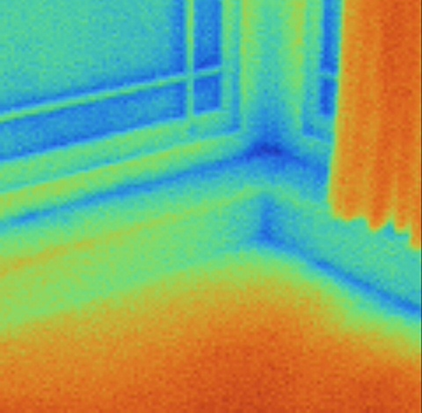
The camera showed us that around the windows there were gaps which would explain the drafts and difficulty to keep some rooms warm especially on a windy day. We were surprised to see that in many rooms there were also gaps between the wooden floors and the skirting boards which the camera, when used inside showed as cold patches, see photo below.
We have now sealed the around the windows and around the skirting boards with Stormguard draught excluder foam which has made a considerable difference to the room temperature.
The Green Team
Home Energy - Act Now to Save the Future!
11th November 2021
ACTING NOW TO SAVE THE FUTURE: Green Steps towards a Greener future
This is a longer version of the first leaflet produced by the Eynsford Green Team and distributed to all homes in Eynsford, to provide information to help us take steps to tackle climate change
Helpful ideas: reducing energy use in our homes
We have provided information to help you save money, help protect the planet and waste less through better energy efficiency in your home. We hope it is also thought provoking; some of the information we've discovered has certainly have made us think!
We had a look at what the energy we buy does for us. The picture shows an average home, so it won't be quite the same as any of our houses but it does give us a reasonable idea of the split.

Whist many of us have roof and cavity insulation and are careful with our heating and lights, what is hugely clear from government and energy experts is that the country's homes must become even more efficient. In fact, a recent report suggested that whilst an average detached home uses about 216 Kwh/year for every square meter of floor space, in future this will need to be reduced to just 50 Kwh/m2. That is a big change.
Want to check how close your house is to the 50Kwh future goal?
You need two bits of information to work out your 'energy use intensity' figure. Firstly look at your energy bills for an actual or estimate of your annual kWh usage. Then you need to work out the area of your 'liveable' space. To do this you need to measure the floor area inside the house, excluding stairs, cupboards and doorways.
The calculation is then annual kWh/m2 of floor. This will give you an estimate of your energy use (kWh) per m2.
So, with winter fast approaching and the cost of gas heating rising fast, we thought it would be useful to start off with some home heating quick energy efficiency wins. And we've been able to borrow a thermal imaging camera for the next couple of months to help us all spot where heat is escaping from our own home.
Quick Wins for energy reduction
1. Insulate your loft or roof: up to 25% of heat loss is through the roof - remember the right level of ventilation is really important (see the guide from the Energy Saving Trust). (Worth checking: lots of houses now have insulation depths below recommended levels AND no insulation across the joists).
2. Insulate your walls - cavity or solid wall. For a qualified supplier go to CIGA.
Home Insulation: Home energy use is driven predominantly by heating and lighting and consequently predominantly by gas and electricity consumption. The climate change impact of electricity is reducing through decarbonisation of the electricity grid, which leaves home heating from fossil fuel use as a tough remaining issue. We can decarbonise supply (see below) and we can reduce demand. The driver of demand is how warm you want your house and how well it retains the heat. It makes sense both to our wallets and to climate change to reduce our demand and therefore insulate our homes and find out where heat losses happen.
One often overlooked area of heat loss are numerous, small draughts around the house. Often around the windows themselves or around the window and door frames. This time of year I go around the house and check for draughts around the windows and doors with the back of my hand. If I can feel them I either using decorators cork to fill the gap (around window sills and doors) or sticky window draught excluder strips in the windows. My experience is by reducing even small draughts a room goes from feeling cool to cosy.
3. Draught proof your windows - you might find it useful to check out the Energy Saving Trust guide to draft proofing. Borrow the infra-red camera to find your house's hot spots.
4. Have your boiler serviced regularly which may make it more efficient; consider upgrading your boiler, and when replacing look at alternatives to gas boilers such as...
- Ground source heat pumps
- Air source
5. Install solar panels : The sun provides an abundant source of clean, renewable energy. This can be converted into electricity using solar photovoltaic panels, usually referred to as 'solar PV'. Electricity generated by a domestic solar PV system can be used to power your home, leading to savings on your electricity bills and reduced demand on the national grid.
How does it work?
Solar PV systems turn sunlight into electricity through the 'solar cells' they contain. Electricity leaves the panel as direct current (DC) and passes through an inverter that converts it to 240V alternating current (AC), so that it can be used in your home. This electricity can then power any appliances that are switched on - washing machine, TV and so on - while the surplus (if there is any) is exported to the electricity grid, or stored in a battery if you have one. There is no longer a fee paid to you for the electricity that goes to the grid but the cost of PV panels and the cost of installing them is coming down. If you do not have a battery the greatest benefit is gained by using your electrical equipment while the sun is shining, so set your washing machine, dishwasher etc. to operate during the day. Alternatively, if you want to use your own energy more, you can have a battery fitted that stores electricity for use when the sun is not shining. The cost of these is also coming down and the capacity is increasing. Look for a certified supplier.
6. Other little things that can make big changes
- when you buy new electrical equipment make sure it is at least A rated and use LED or other low energy lighting
- Turn off lights when not being used, turn down heating by 1 or 2 degrees, put on a jumper if cold, use a stand-alone radiator in one room rather than central heating, bleed your radiators once a year.
Thinking about the whole building!
We've been looking at what the experts are saying about the future of home energy use. The first thing that comes over strongly is that we need to look at the building as a whole - not just do ad-hoc stuff. They recommend a retrofit plan, so working out what needs to be done, maybe over several years, and making sure that one action doesn't cause problems later on.
Renovating a whole house - or wanting to future-proof
It's really important that you have people with the necessary expertise - it may be an architect, an experienced builder or a retrofit co-ordinator. They need to be able to work on technical stuff such as whole house insulation and airtightness, ventilation and thermal bridging. If you want to understand what a retrofit plan should include or just have more information on what your contractor will need to cover see the LETI Climate Emergency Retrofit Guide. It's a rather techy but useful.
Home Improvements
Even smaller changes to your home can be opportunities for better energy efficiency. Here are a few examples:
- New Kitchen - better ventilation, insulation behind units, insulate kitchen floor
- Floor repair/subsidence - floor insulation
- And for jobs such as loft conversions and extensions many builders will already be required to include some of these features……but it is worth checking. And don't forget, if you have an idea of a change you want make in a few years, getting the extension or loft set up for this at the time of building is a lot easier than adding later.
BUT it is also clear that badly fitted or poorly thought through insulation can cause damp problems - make sure you use qualified suppliers.
Alternatives to Gas Boilers
Current Government policy is for gas boilers to be phased out during the next twenty years and replaced with a low-carbon heating system. There has been a lot in the press about the alternatives which we have been trying to understand and The Energy Saving Trust website is a good starting place with lots of detailed but clear information. In summary it would appear either an Air Source Heat Pump or a Ground Source Heat Pump will be the most viable alternative.
Air Source Heat Pump
An air-to-water heat pump transfers heat from the outside air to water, which heats your radiators or underfloor heating and can heat a water tank. They are installed on an outside wall and need good air circulation. They do need a small amount of electricity to run and are only efficient if the home is well insulated.
Ground Source Heat Pumps
A ground source water heat pump transfers heat from the ground outside your home to heat your radiators or underfloor heating. It can also a heat water cylinder. A mixture of water and antifreeze flows around a loop of pipe, buried in your garden. This system is worth considering for new build properties.
Until 31 March 2022 there is the government pay back scheme called the Domestic Renewable Heat Incentive to promote households to use renewable heat, which includes Air and Ground Source Heat Pumps. This scheme is due to end on 31 March 2022 and will be replaced by the Clean Heat Grant in April 2022.
Grants to help make changes
Sevenoaks District Council - there can be up to 100% funding for people in their own or rented homes who are in receipt of a government benefit, a low income and/or in poor health. The scheme is offering to provide new boilers, if the existing one is broken, or home insulation. From what we have read there are a lot of factors that seem to decide if or what can be funded so we suggest you contact the company managing this for Sevenoaks, and all the other councils in Kent. They are Aran, www.aragroup.co.uk/kent, tel 0800 587795 or 01284 812520.
Until 31 March 2022 there is the government pay back scheme called the Domestic Renewable Heat Incentive to promote households to use renewable heat, which includes Air and Ground Source Heat Pumps. This scheme is due to end on 31 March 2022 and will be replaced by the Clean Heat Grant in April 2022.
Borrow our Thermal Imaging Camera - how much energy is my house losing?
In November and December you can borrow a camera from the Parish Council to find out more about your home. A thermal camera is capable of scanning and capturing an overview of the whole building, offering infrared images that clearly identify where you are losing heat.
How does it work?
All objects radiate infrared energy. The amount of energy radiated is based on the actual surface temperature and how good the surface of the object is at emitting heating. The thermal imager senses the infrared energy from the surface of the object and uses this data to calculate an estimated temperature value which is then represented over a colour scale. Many common objects and materials such as painted metal, wood, water, skin and cloth are very good at radiating energy and it is easy to get relatively accurate measurements. Shiny surfaces or unpainted metals do not work as well.

To borrow the camera for one or two days, please contact the parish office on info@eynsfordparishcouncil.org.uk or 01322 865320 to book a slot. We will require a £20 cash deposit for loan of the camera. Full instructions will be provided.
Let us know how it goes!
We're all going to be trying out the camera, checking our insulation and draughtproofing in our own homes over the next few weeks and we hope that this leaflet helps you to cut energy use too.
And finally………..we would love to hear any tips that you have for energy saving and indeed let us know anything you have been able to do this autumn to cut your energy use.
Contact us with your ideas or feedback at info@eynsfordparishcouncil.org.uk
Electric Charging Points in Eynsford
12th October 2021
Eynsford Green Team - Electric Cars and Electric Public Charging Points
Electric Cars would appear to be the future…..
The Government has made a commitment to achieve net zero emissions by 2050. Road transport is responsible for about one fifth of emissions and the Government are therefore encouraging the transition to electric vehicles. From 2030 it will not be possible to buy a brand new petrol car.
The village survey we carried out about the environmental challenges last year highlighted 45% of respondents said they do or plan to have an electric car within the next 5 years. Of those 45%, 20% said they are unable to charge their car at their home.
The ownership of electric cars will increase over the coming years and charging points will be needed in the village for those residents with no off-street parking.
What have Eynsford Green Team been doing in response to the need for a village charging point?
In light of the above we investigated the possibility of a community electric charging point.
Kent County Council is offering financial support to parish councils to install charging points in their villages on community land for those residents that cannot access off-road parking and charging. We looked into various locations, including the village car park which is owned by Sevenoaks District Council. SDC refused our request for a community charging point stating that "use would be minimal and could result in the space remaining empty for substantial periods of time".
It would be interesting to know what residents think, are you local to the car park, have or want an electric car and would use the charging point? Or do you agree that the spaces should be saved for residents and visitors with petrol cars only? It may be that we can campaign on this if enough residents come forward stating they would use the charging point. Let us know your thoughts.
We also looked into the Parish Office car park currently leased to the Scout Association however due to the Scouts concerns over safeguarding issues this is not an option.
The new village hall site does have plans for electric charging points but this will be a few years away.
Other possible locations
There might be other village locations that may be suitable for a charging point. Whilst these are not local authority land and would not qualify for the current grant, there may be alternative options and schemes for such charging points. We have been in contact with Darenth Valley Community Rail Partnership who work closely with Southeastern and Network Rail, and they are looking into installing one or more charging points at Eynsford station.
We are also looking to local businesses and whether they would be willing to have a charging point. Do you have a business in the village with room for a charging point? If this is something you may consider please do get in touch with us.
Other Government Schemes
The Government is also providing funding to local authorities for installing on-street charging points in residential areas. We haven't yet explored this with Sevenoaks DC as we were hoping to apply for the grant detailed above but this is something we will start looking into.
Community Electric Charging
One idea is for residents to share charging points on their driveway. There are services that enable people with home charging points to share their charger with the public, for example, www.co-charger.com.
Emerging technology
Technology is rapidly changing for charging points. Charging points can be now found in lamp posts around London, customers purchase a smart cable that connects to the lamp posts. Perhaps the village lamp posts could be utilised in this way.
There are also kerbside charging points being developed by a company called Connected Kerb and Urban Electric are working on charging points sunken into the ground when not in use. With space at a premium in many towns and villages and the need to keep pavements free of clutter, these could be brilliant solutions.
Map of electric charging points
The zap map is very useful to find your local charging point. It would appear from the map that Brands Hatch Hotel and Otford Village hall car park are our nearest public charging points.
The link below is for a map showing the density of public electric charging devices by each local authority. Sevenoaks DC is within the second to lowest category within the country.
www.maps.dft.gov.uk/ev-charging-map/index.html
Summary
The Eynsford Green Team have been working hard trying to find a location for community charging points however space is at a premium and there is no easy solution. We will continue to look for solutions with the aim to help those residents who don't have an off-street charging option.
Do let us know your views on the above, at info@eynsfordparishcouncil.org.uk.
Photo by Michael Fousert on Unsplash
Brownies Help Eynsford Reduce Waste
5th October 2021

Pictured: Brown Owl, Brownie and Eynsford Parish Council's Chair of Community and Green Team member.
Eynsford's Green Team worked with our local brownie group to obtain a new recycling bin.
We were pleased to gain the support of 2nd Farningham & Eynsford Brownies in our pleas to Sevenoaks District Council for a recycling public waste bin. The Brownies spent some time during lockdown working on the Take Action theme of the new girlguiding programme to raise awareness about an issue important to them. One of the Brownies, who was concerned about waste and recycling, wrote a letter and created a petition asking for recycling bins in the village which she sent to Eynsford Parish Council. The parish council's Green Team was able to use this letter to back up their request for a new bin for Eynsford.
We are all delighted that the new bin has now been installed on Riverside. It is a 'smart' bin and can communicate with the depot to indicate when it is full! This means that fewer wasted journeys are made when the bin is not full, saving fuel and cutting carbon emissions. We hope that in the future we may be able to obtain more of these bins for the village.
The Brownie rightly obtained her Make Change and Speak Out badges and is well on her way to achieving her Brownie GOLD award!
Let us know what you think of our new bin. Would you like to see more opportunities to recycle your rubbish in Eynsford?
What bin does this go in? - Understanding plastics
20th July 2021
Are you confused by recycling? Do you think - can I recycle this? do I have to wash it first? what is the point?
A new project has been launched in Kent to help us to understand all about recycling- particularly plastic products. This article is mostly information provided by Pledge2recycle:
KENT RECYCLES - DO YOU?
Are you confused about what plastics you can recycle?
Pledge2Recycle Plastics are working with all Kent Councils to help reduce that confusion.
The charity, which works to educate and advise citizens has set up a dedicated website for Kent [www.pledge2recycle.co.uk/kent] which includes competitions for communities and general recycling guidance.
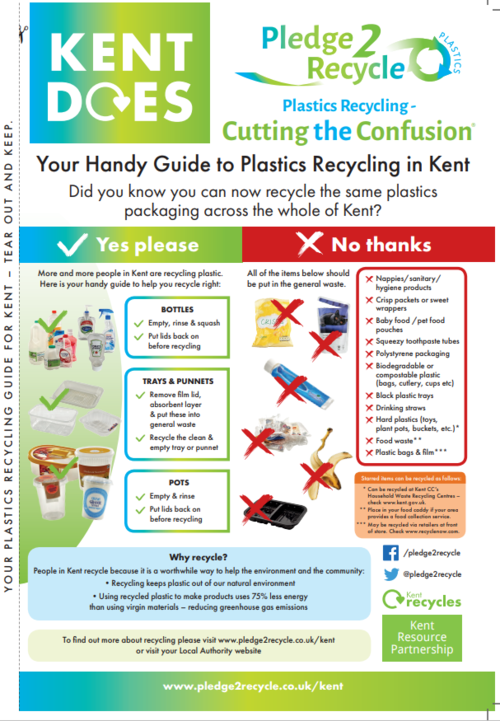
Did you know you can recycle ALL bottles whether from the bathroom and kitchen as well as plastic packaging in the form of a pot, tub or tray?
All bottles should be empty when placed for recycling with the tops back on. Pots, tubs and trays should have the absorbent layer and film lid removed as these need to go into general waste.
Please DO NOT PUT toothpaste tubes, pill packs, nappies, textiles, coffee pods, batteries and food into recycling. Textiles should go to specific banks either at community/retail/or Household Waste Centres. You can take carrier bags, bread bags and empty frozen veg packets, to your local supermarket front of store collection please check at www.recyclenow.com/local-recycling. Sainsbury's superstores now take ALL flexible packaging in front of store collections - guidance and a list of participating stores can be found at www.about.sainsburys.co.uk/sustainability/plan-for-better/our-stories/2021/flexible-plastics.
It is important that ALL PLASTIC PLACED FOR RECYCLING is CLEAN, DRY AND LOOSE and NOT in any carrier or black bags.
PLEDGE2RECYCLE PLASTICS - CUTTING THE CONFUSION - FREQUENTLY ASKED QUESTIONS
•Why do I need to put the tops back on the bottles before recycling?
- The tops go with the bottles to the
reprocessor where they are cut up into flakes and the bottle and tops (which
are different plastics) are separated before they are turned into pellets. The pellets made from the bottle themselves
are then sent to either make new bottles.
The pellets made from the tops are sent to go into garden furniture or
items for construction such as piping or traffic cones
•How clean does my recycling need to be? - At the Materials Recovery Facility
(MRF) all the mixed dry recycling is sorted by type (paper, cardboard, steel
cans, aluminium cans, and plastics).
This process involves a lot of complex machinery which gets covered in
the residue and dirt that householders place in their recycling bins. This residue can cause machinery to
breakdown. Many UK MRF's also have a
section where material is hand sorted, so not a pleasant job if the material is
covered in food remains. Remember also
that the cleaner the recycling is the greater the quality and higher value the
material will be to the recycler. It
also keeps your bin clean if you empty, rinse and dry before recycling.
•Can I recycle my bleach bottles? - Yes, make sure they are empty and
put the top back on.
•What do I do with the film lid on food, fruit, and vegetable punnets? - Remove the film lid and the
absorbent layer and put these into general waste as these are not recyclable at
the moment. Make sure the tray or
punnet is empty, clean, and dry and recycle.
•Where can I recycle my carrier bags, and bread bags? - Many UK Supermarkets are now taking carrier
bags and bread bags etc. in their front of store collections. Please look for the OPRL label on your soft
plastics and wrappings and check out our links on www.pledge2recycle.co.uk/kent for further information.
Should I stop using plastic packaging? - Plastic packaging provides many benefits to products and compared to alternative materials it uses less energy to produce, reduces transport costs and CO2 emissions because it is lightweight, and significantly reduces the amount of fresh food waste by protecting it in a hygienic environment and extending its shelf life.
Did you know?
- bananas in a flexible bag extend their shelflife by3days
- Plastic bags reduce waste of potatoes by two thirds
- Cucumbers extend their life when wrapped in film by 14 days
- Advanced plastic packaging extends the life of steak upto10 days
Why do some brands still use plastic for food products - surely, we can use other materials such as glass?
Because it is lightweight, plastic packaging can save energy in the transport of packed goods. Less fuel is used, there are lower emissions and there are cost savings for distributors, retailers and consumers. For example, a yoghurt pot made from glass weighs about 85 grams, while one made from plastic weighs 5.5grams. In a lorry filled with a product packed in glass jars, 36% of the load would be accounted for the packaging. If packed in plastic pots, the packaging would amount to just 3%. To transport the same amount of yoghurt, three trucks are needed for glass jars but only two for plastic pots.
•What can plastic packaging be recycled into?
Plastic packaging can be recycled into a wide variety of products including clothing, t-shirts; toys, chairs and tables; headphones; kitchen utensils; paint pots; car parts; cuddly toys; filling for duvets and sleeping bags; pens and pencils; building materials such as fencing, flooring, piping, etc; garden furniture; buckets and - of course - more plastic packaging! Drinks bottles can be made back into drinks bottles, milk bottles can also be made back into more milk bottles.
•Why don't all Councils collect the same types of plastic?
Local authorities use different facilities and waste management providers to collect recycling materials from households and recycling points. Some of these can only accept specific plastic types and therefore residents are given different messages about what they can and cannot recycle in different areas. Local authorities also have contracts with waste management providers and changing or terminating these can be a long and costly process. However, the plastic industry would like to see all councils collecting the same types of plastic and will continue to promote this as best practice and the UK government is discussing the possibilities of consistent collections across the UK.
If you live in Kent and one of the 13 Kent Councils you are, able to recycle the same plastics packaging wherever you live in Kent.
•Why does the Council keep asking us to recycle when I think I recycle everything I can?
Although most of us do recycle what we can when we can unfortunately the data tells us that nationally we only recycle 59% of all the bottles we could recycle and 34% of the pots, tubs and trays. This may be because we are not sure if they are recyclable, or because they are dirty and we don't want to rinse/empty them, or because we take them out of the home for eating and drinking on the go and dispose of then in general waste wherever we happen to be, office, school, travelling etc. If we, can it is always best to take our empties home to recycle and make sure that we are not forgetting to recycle stuff from the kitchen or the bathroom, or forgetting about the ketchup and mayonnaise bottles. It all adds up.
The team at Pledge2Recycle Plastics are happy to take your queries you will find them @pledge2recycle or e-mail Amanda.bakewell@recoup.org.
- The tops go with the bottles to the
reprocessor where they are cut up into flakes and the bottle and tops (which
are different plastics) are separated before they are turned into pellets. The pellets made from the bottle themselves
are then sent to either make new bottles.
The pellets made from the tops are sent to go into garden furniture or
items for construction such as piping or traffic cones
Eynsford Tree of the Year
1st April 2021
Eynsford Tree of the Year - A Celebration of our Village Trees
Nominate Your Favourite Tree!
You may be aware of the Woodland Trust's annual Tree of the Year contest (https://www.woodlandtrust.org.uk/trees-woods-and-wildlife/british-trees/tree-of-the-year/) which aims to showcase the UK's favourite trees to help promote their value and need for protection.
We thought it would be fun to do a similar contest for our village trees, after all we are the place where Arbor Day first started in the UK in 1897!
So, do you have favourite tree in the village? Perhaps a tree which you think is a perfect example of that species. Alternatively, is there a tree in the village that makes you smile or brings back happy memories? Or maybe a tree which you think embodies Eynsford village?
If so, then why not nominate it for Eynsford Tree of the Year. To nominate your tree please email info@eynsfordparishcouncil.org.uk or drop in a note to the parish office, and tell us;
-which tree you wish to nominate (the tree must be within Eynsford parish)
-a few lines about why you are nominating this tree. -the location of the tree, and the species (if you know it)
-and ideally please include a photoNominations need to reach us by June 2021. The winner will be chosen by our Tree Wardens and a representative from our Green Team. The winning tree will be unveiled, rather more Arbor than Oscar-style, the following month. There are no prizes if your chosen tree is picked - it's just for fun. But, the winning tree and it's story, will be featured on our website, social media and in our next newsletter.
The Arbor Day Movement was established in America in 1872 where one day each year is set aside as a festival to plant trees. A similar event was established in England in 1897 in the Kent village of Eynsford.
by Jane Laird for Eynsford's Green Team

